
On International Women’s Day, stories of leadership, resilience, and institutional change take center stage. Few illustrate those themes in Kenya’s media sector more clearly than the career of Rosemary Okello, a veteran journalist, media advocate, and academic who has spent decades building platforms for women, strengthening media governance, and mentoring the next generation of journalists.
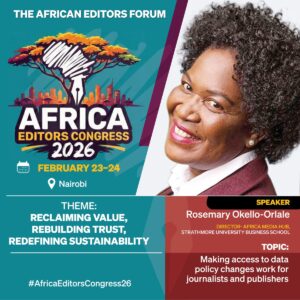
Today Okello serves as director of the Africa Media Hub at Strathmore University Business School, where she works at the intersection of journalism, policy, and digital transformation. Yet her journey reflects a broader story about how women reshaped Africa’s media landscape over the past three decades.
Building a Voice for Women in Media
Okello’s advocacy for gender representation in journalism began in the 1990s, when she co-founded the African Women and Child Feature Service in 1994. The network emerged from a stark realization: women’s voices and children’s rights were rarely reflected in mainstream news coverage.
At the time, many newsrooms lacked policies addressing gender representation, and female journalists were often assigned what editors called “soft” stories rather than political or investigative reporting.
The initiative connected women journalists across Africa and the Global South. It was developed in collaboration with international media advocates including Colleen Lowe Morna, associated with the Women’s Feature Service based in New Delhi.
The goal was simple but ambitious: ensure that women’s perspectives were represented in global conversations—from local communities to international policy forums.
The Birth of a Media Institution
Okello also played a foundational role in establishing the Kenya Editors Guild, now one of the most influential media institutions in the country.
The idea traces back to a continental gathering of journalists in southern Africa in the late 1990s under the African Editors Forum.
During that meeting, participants had an opportunity to engage with Nelson Mandela, who challenged media leaders to strengthen professional accountability and governance in the industry.
Mandela’s question was direct: if journalists champion democracy and freedom of expression, should they not also build strong institutions to uphold those values?
Inspired by that challenge, Okello and other editors returned to Kenya determined to create a national body that could bring newsroom leaders together. She convened what became known as the “Editors’ Breakfast,” where senior editors discussed the need for a collective voice.
With support from leading media executives including Wilfred Kiboro, the Kenya Editors Guild was formed. Okello became its first secretary.
The Guild helped unify editors across media houses and strengthened their ability to respond collectively to threats against press freedom, including the arrest or harassment of journalists.
Shaping Media Policy in Kenya
The establishment of the Guild also helped catalyze broader reforms in Kenya’s media governance.
At the time, the country lacked a formal independent regulator for the sector. Discussions involving the Guild eventually contributed to the creation of the Media Council of Kenya, which now oversees professional standards and accreditation in the industry.
Okello recalls that registering the Guild required sustained engagement with government officials, including Kalonzo Musyoka, who served as Minister for Information during the period.
The result was an institutional framework that strengthened both media freedom and accountability.
Expanding the Gender Agenda
Okello’s advocacy also extended beyond Africa’s borders.
Through networks of women editors, she participated in initiatives that brought gender perspectives into international policy debates. During major global gatherings—including United Nations conferences—women journalists produced daily publications highlighting gender priorities and ensuring that women’s voices were part of international discourse.
The work aligned with global gender equality frameworks such as the United Nations-led Beijing Platform for Action, which called for stronger representation of women in decision-making.
For Okello, the lesson was clear: structural change requires both policy reforms and individual commitment.
Mentorship and the Next Generation
A recurring theme in Okello’s career is mentorship. She often credits the mentors who helped shape her path, while emphasizing the responsibility of experienced journalists to guide younger professionals.
“Every one of us can mentor a leader for tomorrow,” she says.
Today she continues that work through the Africa Media Hub, focusing on digital transformation, artificial intelligence, and data-driven journalism.
Young journalists, she argues, are entering the profession already immersed in social media platforms—from TikTok to other digital networks. The challenge is to channel that energy into rigorous journalism that informs public debate and shapes policy.
Investigative reporting, analytical storytelling, and fact-based journalism remain essential—even in the age of AI.
A Continuing Journey
International Women’s Day is both a celebration and a reminder of unfinished work.
Okello points to pioneers such as Phoebe Asiyo and Wangari Maathai, whose leadership helped open political and social space for women in Kenya.
Yet she acknowledges that gender equality in the media sector—and in leadership more broadly—remains an ongoing struggle.
For young journalists entering the profession today, Okello offers a clear message: specialize, build expertise, and use journalism to serve the public good.
Media, she notes, has always been about storytelling.
Long before modern newsrooms existed, communities relied on storytellers—often grandmothers—to pass on knowledge and history.
That tradition continues today, evolving through digital platforms and global networks.
For Okello, the mission remains unchanged: ensure that the stories shaping society include the voices that were once left out.

