
By Kiarie Irene Wambui and Beatrice Kivindyo
Kenya’s mounting debt burden, rising cost of borrowing, and growing secrecy around public finances have come under scrutiny, with journalists, lawmakers, economists, and oversight bodies calling for greater transparency and stronger public accountability.
At a media and institutional dialogue in Nairobi, participants warned that Kenyans are struggling to understand borrowing decisions that increasingly affect the money available for essential services, businesses, and households.
The forum, organised by the Kenya Editors Guild in partnership with the International Republican Institute (IRI), brought together journalists, editors, legislators, economists, governance experts and accountability institutions to examine public borrowing and financial management.
The scale of the pressure was highlighted by figures presented at the meeting. Of about Sh2.9 trillion collected in the previous financial year, more than Sh2.1 trillion went towards debt repayment, leaving less than Sh1 trillion for service delivery at national and county levels.
IRI Country Director Francis Rodgers, whose remarks were read by IRI Programmes Lead Apollo Edewa, said public concern about debt was particularly strong among young people but was often not matched by access to reliable information.

“Many young people hold strong views about public debt without necessarily having access to accurate, sufficient, contextualised information,” Apollo said.
He warned that the information gap could fuel speculation and misinformation. “When information is fragmented, inaccessible, or highly technical, the resulting vacuum can easily be filled by speculation, misunderstanding, or misinformation,” he said.
Apollo said accountability should go beyond the size of the debt to examine how borrowing decisions are made, whether financing arrangements are transparent, and whether loans deliver value to citizens.
“Accountability is not simply about the size of debt. It is about the quality of the decisions, the transparency of financing arrangements, and the public value ultimately being generated,” he said. “Ultimately, transparency strengthens accountability, and accuracy strengthens trust.”
Kenya Editors Guild President Zubeidah Kananu urged journalists to remain firm when reporting on public finances despite pressure or intimidation.
“Faced with harassment and intimidation, journalists must not retreat, soften their questions, or bow to pressure,” she said. Kananu said decisions made at national and county level have direct consequences for ordinary Kenyans.

“National financial decisions are not abstract concepts; they are lived realities that affect classroom resources, hospital supplies, and basic livelihoods,” she said.
Meanwhile, attention turned to the growing financial pressures in Kenya’s 47 counties, where pending bills had reached about Sh181 billion by the end of the 2023/2024 financial year.
Homa Bay Senator Moses Kajwang’, who chairs the Senate Public Accounts Committee (SPAC), said only 11 counties met the required fiscal responsibility standards, while 16 spent more than half of their budgets on salaries. He also criticised counties for failing to properly disclose their liabilities, making it difficult for incoming governors and oversight bodies to establish the true extent of their obligations.
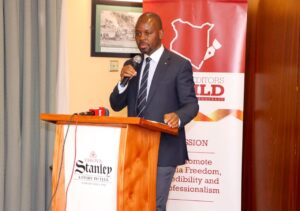
“Counties are not disclosing their liabilities. So you come in as a new governor, you don’t know what you are supposed to pay,” he said.
Kajwang’ said weak county assemblies had created oversight gaps and defended the Senate’s decision to keep its proceedings accessible to the public.
“We are not going to turn off the livestream,” he said. He also raised concerns over counties deducting statutory contributions from workers without remitting the money to the relevant institutions.
The Institute of Economic Affairs Chief Executive Officer Kwame Owino called for greater scrutiny of both domestic and external borrowing, warning that government borrowing can crowd out businesses by encouraging banks to lend to the State rather than the private sector.
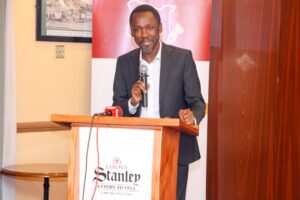
“We need government reporting and external verification, making sure that budget records and public debt records are clean,” he said.
“The Government of Kenya borrows a lot of money, which means that Kenyan banks and financial institutions lend to the government and not to businesses,” Owino said.
Owino rejected the argument that counties are responsible for the country’s growing public debt. “Is public debt exploding because of counties? And the answer… is no,” he said.
Head of Research, Capital A Investment Bank, Churchill Ogutu explained that government borrowing increases when expenditure exceeds revenue, with financing raised locally through Treasury bills and bonds and externally through foreign-currency loans and bonds.
But heavy borrowing, he warned, can raise interest rates and make credit harder for businesses and households to access.
“It is safer for the bank to lend to the government, and because of that they don’t have resources to lend to the public,” he said.
The meeting also exposed continuing concerns over access to public information, particularly details on government expenditure, procurement, and debt contracts.
Simon Nzioka, Chief Access to Information Officer at the Commission on Administrative Justice, said public institutions often disclose information about their mandates but remain reluctant to reveal details of spending and contracts.
“The law requires information about the service provider, the contract sum and the timeline to be disclosed,” he said.
Activist and TISA Head of Programmes Alexander Riithi questioned the National Treasury’s failure to comply with a High Court order requiring it to release debt contracts within 45 days.
“The High Court ruled in our favour and gave the National Treasury 45 days to provide us with the debt contracts. However, this did not happen,” he said.
Riithi said the failure had forced them back to court to pursue contempt proceedings.
“We need to be able to tell Kenyans who we actually owe, how much we owe them, and what the payment details are,” he said.
Nzioka said the reluctance by public institutions to disclose financial information reflected a wider culture of secrecy.
“They just want to thrive in that secrecy; they don’t want to be held to account by citizens,” he said.
The forum agreed to establish an Issues, Referral, and Follow-up Matrix to track unanswered questions, identify institutions responsible for providing information, and monitor progress. A second institutional dialogue will then require the relevant institutions to respond formally to the issues raised.
For Rodgers, the challenge is ultimately not just Kenya’s debt numbers but how borrowing and public finances are explained to citizens.
“It is about how the issue is handled, how it is processed, and how it is communicated to the public in ways that present the truth and bring out the appropriate problems rather than just politicising it,” he said.

